

What is Unidirectional Carbon Fibre Tube?
Unidirectional (UD) carbon fiber tubes are made from UD carbon fiber fabrics and prepregs, and are characterized by their fibers running in a single, parallel direction. This orientation of the fibers gives the tubes strength and stiffness.
Why Choose Us
High Quality
The main business is to produce various kinds of pultrusion, roll-wrapped, filament winding products based on carbon fiber, fiberglass and other advanced composite material.
Rich Experience
We can control the production process with our superior facilities, advanced technology and rich experience, and provide customization service from designing, processing, prototyping, testing to producing.
Quality Control
We have standard quality control system for each manufacturing process and make 100% inspection of the finished product before packed. Small quantity order is acceptable.
24H Online Service
We usually reply emails within 24 hours. If you need any support regarding our products, please contact us immediately.
-

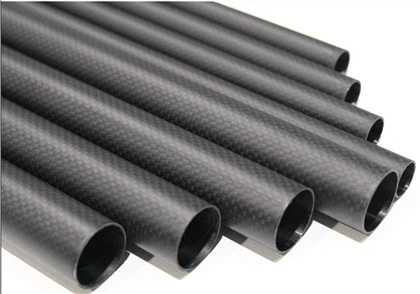
Plain Black 16mm Carbon Fiber Tube
Runfeng CFRP produce the plain black 16mm carbon fiber tube. Our tubes are made of carbon fibres and epoxy resin, and with a accurate 16mm inner diameter, the wall thickness and length can be Add to Inquiry -
Tapered Carbon Fiber Tubes
Tapered carbon tubes are widely utilized for carbon tail booms, golf shafts, ski poles, pool cue shafts, and other industrial and sporting applications. Add to Inquiry -
Glossy Hollow Carbon Fiber Rod
*Standard modulus, high modulus carbon fibre or ultra high modulus carbon fibre are available. *Diameter range from 2mm to 600mm with max length 6000mm Add to Inquiry -
Matte Finished 10mm Carbon Fiber Tube
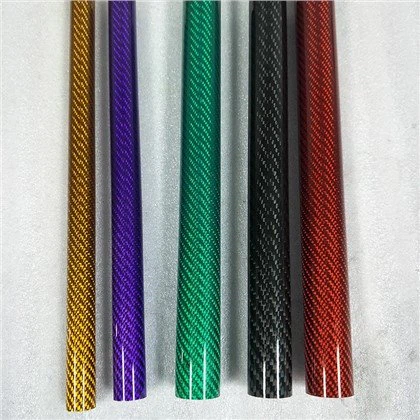
We are manufacturer direct sales, the matte finished 10mm Carbon Fiber Tube distributor price We can accept customized logos, sizes, and color services are also available Hollow Carbon Fiber Rod Add to Inquiry -
Carbon Fiber Rods and Tubes
Runfeng CFRP’s carbon fiber rod and tubes are made from multi-layer carbon fiber prepreg by the roll wrapping process. We can customize the fiber layer’s orientation based on requirements and Add to Inquiry


Applications of Unidirectional Carbon Fibre Tube
Unidirectional tubing is so named due to the alignment of the carbon fibers.Suffice it to say that unidirectional tubing is suitable for a wide range of applications – whether straight up or finished with an outer layer of woven fabric.
Unidirectional vs. Multidirectional
As previously mentioned, 'unidirectional' relates to how carbon fibers are aligned. In the case of unidirectional tubing, you can see that all of the fibers on the outside of the tube run in the same direction as do most of the other layers in the tube. They are parallel for all intents and purposes. Contrast this to a multidirectional material.
A multidirectional tube presents the telltale woven appearance. There is good reason for that. When you run fibers in multiple directions, you weave them together to create a fabric. That is the whole point of weaving. The woven appearance is what most people think of when they consider carbon fiber parts.
So why go unidirectional instead of multidirectional? It really depends on how much strength you need and where you need it. Carbon fiber itself is a reinforcing material; it is combined with epoxy resin to create a carbon fiber reinforced polymer (CFRP). Most of the tensile strength a carbon fiber part offers is in relation to fiber alignment.
Strength in the Same Direction
Carbon fiber's tensile strength tends to run in the same direction as the fibers. Thus, a unidirectional tube is very strong along its length. Its tensile strength is essentially back and forth along the entire length of the tube. By contrast, a multidirectional tube exhibits tensile strength in multiple directions.
An ideal application for unidirectional tubing is bicycle tubing. Bike designers want superior longitudinal rigidity for bike frame components. Depending on the part, they may not need multidirectional strength. However, some bike makers prefer their unidirectional tubing be wrapped in an outer layer of woven fabric. They want the look of the weave for aesthetic purposes and the fabric helps contain fibers if the part does in fact fail.
Adding that outer layer gives them the aesthetic they want. As an added bonus, the layer provides some extra rigidity across the entire surface of the frame.
Unidirectional tubing is ideal for applications involving movement and stress only in back and forth directions. On a grand scale, rocket bodies are good candidates for unidirectional tubing. On a smaller scale, unidirectional tubing is also ideal for model rockets, lacrosse sticks, and so forth.
Increasing Tube Strength
One last thing to know about unidirectional tubing is that strength can be increased in key areas by adding extra layers. Consider an application where two or three tubes meet at a common joint. If that joint is subject to stress from multiple directions, the tubing can be reinforced by a layer or two of woven fabric.
This is one of the benefits of choosing carbon fiber over metal materials. Just by adding additional layers of woven fabric in key locations, fabricators can increase strength while adding very little weight. It is not so easily done with aluminum, steel, or titanium.
Properties of Unidirectional Carbon Fibers
Strength and light-weighting
UD fibers constitute perfect light-weighing solutions with greater longitudinal tensile strength — making them ideal for isotropic applications. The more uniformity of fiber distribution, the higher the resulting strength.
It can be customized flexibly for strength-related applications — adding a single layer of UD carbon fibers will add double the strength in the required direction compared to a woven fabric that has fibers running in two or more directions.
Stiffness
They are fairly stiff (i.e., hard to deform) — both an advantage and a disadvantage for certain applications, as they don't make for ideal contouring materials because of their rigidity.
Drapability
Unidirectional carbon fibers aren't suitable for draping. They reveal gaps, wrinkles, or creases when draped over complex surfaces. But their drapability can be changed or rather improved with resin infusion.


Manufacturability
Unidirectional fibers tend to fall apart during the layup process because they are non-woven. But their layering can be made creative — many UD fabrics can be layered in different directions for maximum strength without sacrificing their stiffness or lightweight.
Machining
Non-woven fabrics cannot be as easily machined as woven ones, where the overlapping fibers rebound comparatively. And, unlike woven fabrics, a fiber pull-up in UD can go all the way across without interlaced fiber support.
Crimping
Crimp refers to the waves or undulations in fiber — the lesser the crimp, the better the composite mechanical properties. No cross-sectional weave means less or no crimping of the fibers — i.e., the fibers lay flat without any gaps or bumps.
Relatively economical
Considering the exceptional performance of their applications, UD fibers remain rather inexpensive — not to forget all the savings due to their simple production.
Apart from the many properties unique to the unidirectional orientation of the fibers, they also obviously carry the properties of the carbon fibers themselves — like temperature and chemical resistance, durability, sustainability, and high electrical and thermal conductivity.
Unidirectional vs. Twill Carbon in Wrapped Carbon Tubes
When you think of a carbon-fiber, you probably envision the woven, cross-hatch look found in so many consumer products. However, many of our rods and tubes are made with unidirectional carbon, where the carbon fibers are all oriented in the same direction. But why? Is there truly an advantage to twill carbon, other than just looking cool? The answer, of course, is "it depends." Twill carbon fabric and unidirectional carbon fabric have different properties that make them excellent choices for different applications.
Twill Carbon Fabric
Twill Carbon Fiber Fabric is what most people think of when they say "Carbon Fiber." It is a geometric weave that looks like it is two-toned in color because of the way the fibers reflect the light. Both unidirectional and twill carbon fabric use the same carbon fibers, but the twill is woven, so the fibers are oriented at 90-degrees (perpendicular) to each other. The weave provides more drapability: the ability for it to conform to different three-dimensional shapes. Additionally, the resin content in prepreg (pre-impregnated) twill fabric is higher because there are more gaps in the material that must be filled.
Benefits of Twill
● Drapability: Twill fabric can conform to three-dimensional shapes because the fibers weave through one another and bend over and under each other. Twill follows curves better than unidirectional carbon fabric.
● Impact protection: The weave, with fibers lying perpendicularly across one another, can resist impact and deformation a bit better than unidirectional fibers.
Drawbacks of Twill
● Lower stiffness: Compared to unidirectional fabric, twill is not as stiff because the fibers lie perpendicular to each other and because they weave over and under each other do not lie perfectly flat.
● Cost: Twill carbon fabric is more complicated to manufacture because it must be woven, so it is three-to-four times more expensive than unidirectional carbon fabric on average.
Unidirectional Carbon Fabric
Unidirectional fabric has all the fibers nestled together and lying in the same direction. When we layer a sheet of unidirectional fiber on top of another unidirectional fiber sheet, we can oppose the layers to have fibers running anywhere between 0-degrees and 90-degrees to the layers before and after. This layering of unidirectional fibers in different orientations to one another provides for infinitely custom configurations of a wrapped carbon tube. The finish on a unidirectional wrapped carbon tube or a unidirectional pultruded rod or tube is flat black and can be easily ground or painted.
Benefits of Unidirectional Carbon
● Stiffness: Unidirectional rods and tubes have higher stiffness-to-weight ratio than twill because the carbon fibers are all lying flat and oriented in the same direction. If your goal is a light, stiff tube, unidirectional carbon is the best option.
● Cost: Unidirectional carbon is commonly used for structural applications and is easier to manufacture than twill, resulting in products that are much less expensive than twill.
● Customization: Unidirectional fabric can be laid up in a multitude of different orientations so the properties of the tube fit end-use goals as efficiently as possible. We can build layers for deflection, hoop strength, impact resistance, and more.
Drawbacks of Unidirectional Carbon
● Difficult to drape: Unidirectional carbon fabric does not easily conform to multiple curves in a three-dimensional product.
● Appearance: A unidirectional carbon rod or tube is plain black.
As you can imagine, the right choice for a composite rod or tube is most often unidirectional carbon. For our wrapped carbon tube customers who love the look of twill but do not require the properties of twill, we can often do a final wrap of the tube in a layer of twill. This will give a tube that great, woven finish without multiple layers of expensive fabric. The underlying layers can be customized for maximum benefit with unidirectional, twill, or a combination of both.
How to Make a Roll Wrapped Carbon Fibre Tube?
In this tutorial you can learn how to use a metal mandrel, prepreg carbon fibre and shrink tape to produce a bespoke carbon fibre tube using the roll wrapping process.
The roll wrapping process is used by composite manufacturers to produce high strength carbon fibre tubes, either with a basic unfinished appearance or with a cosmetic finished appearance. Sometimes however, the need arises for a carbon fibre tube of very specific dimensions, fibre type/orientation or appearance.
Providing the tube you wish to make has parallel sides or a continuous taper then it is possible to use the roll wrapping process to make your own bespoke carbon fibre tube without the need for any specialist machinery beyond a metal mandrel of the right size and an oven large enough to cure the tube in.
If, instead, you need to make a carbon fibre tube that is not straight, such as handlebars or a more complex tubular frame structure such as a suspension wishbone or bike frame then take a look at our tutorial on making a carbon fibre tube using a split-mould. Explained below are the materials and processes used in the tutorial.
Metal mandrel
The roll wrapping process involves wrapping prepreg carbon fibre around a metal mandrel and so the starting point is to have a metal mandrel of the correct diameter for the size tube that you want to create. Because the carbon fibre will be wrapped around the outside of the mandrel, the mandrel itself needs to have an outside diameter that matches the inside diameter of the carbon fibre tube you will use it to make. The outside diameter of your carbon fibre tube will be determined by the amount of reinforcement (the number of layers) you wrap around the mandrel.
In the video we use an aluminium mandrel because the high coefficient of thermal expansion (CTE) of aluminium makes it well-suited to the roll wrapping process. Steel or other metals can be used but metals with higher CTE will make the process easier.
If you want to produce a tapered carbon fibre tube then you will most likely need to use a lathe to turn down a solid aluminium rod to create a tapered mandrel.
Once you have a correctly sized mandrel, ensure it is completely clean and as smooth as possible to aid with extraction. The mandrel should then be thoroughly prepared with a high temperature chemical release agent, such as Easy-Lease.
Prepreg carbon fibre
Although in theory it may be possible to use alternative types of reinforcements, such as a dry fabric wetted out with an epoxy resin, in practice only prepreg carbon fibre offers the precision and ease of handling required for the roll wrapping process.
In the tutorial we use a layer of XPREG® XC110 210g woven prepreg on the inside of the tube, followed by several layers of XC130 300g unidirectional prepreg, finished with a final layer of the XC110 210g woven prepreg again on the outside of the tube. Because the woven prepreg has fibres oriented in the 0° axis (down the length of the tube) and in the 90° axis (around the circumference of the tube) these layers add what is known as hoop strength to the tube, making the tube less vulnerable to crush or burst forces and splintering. The bulk of the reinforcement, in the 0° axis, gives the tube its longitudinal stiffness.
By altering the layup to include more or less woven layers or by changing or alternating the orientation of the unidirectional plies allows the performance of the tube to be precisely optimised for its specific use. For example, a tube for a prop-shaft will encounter primarily torsional forces and so the unidirectional fibre can be aligned off-axis, at 45° for example, specifically to handle these forces.
Composites shrink tape
Once the prepreg carbon fibre reinforcement has been wrapped around the mandrel as tightly as possible, the reinforcement is then tightly wrapped with a composites shrink tape to provide further consolidation.
When applying the shrink tape it is important to ensure there is lots of overlap. Each wrap of the tape advances only a few millimetres down the tube. Although time consuming to do by hand, having lots of overlap in this way will provide much more consolidation pressure when the tape contracts during the cure.
Oven cure
Besides the mandrel, having an oven to cure the tube in is likely to be the main limiting factor when considering the roll wrapping process outside of a full production environment. However, unlike other prepreg processes, the roll wrapping process does not require precise temperature control or the multi-step 'ramp and soak' cure cycles often needed. Nor does the process require an active vacuum line into the oven. Therefore, the only requirements for an oven to cure a roll wrapped tubes are basic temperature control and sufficient size to fit the tube in. Depending on the size of the tube you want to make, anything from a domestic oven to a powder-coating oven could be used.
Our Factory
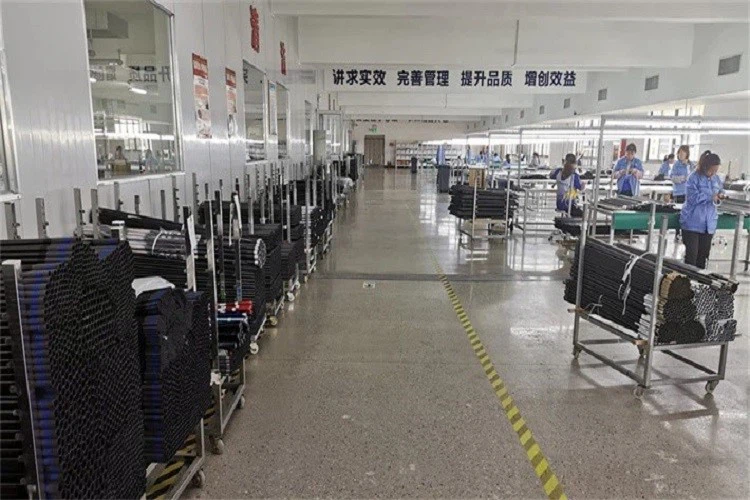
Shandong Runfeng CFRP Co., Ltd was founded in 2010, and located in Shandong, China. We assist customers in the development and manufacture of carbon fibre, glass fibre, and aramid fibre products. Our products are widely used in areas of high-end industrial machinery, medical equipment, intelligent robot, security equipment, transportation, marine antenna, sporting goods, photography facilities, etc. With superior facilities, advanced technology and good quality, we provide one set-up customization service from designing, mold making, prototyping, testing, producing to transportation.

FAQ
We're professional unidirectional carbon fibre tube manufacturers and suppliers in China, specialized in providing high quality products and service. Please rest assured to buy customized unidirectional carbon fibre tube at competitive price from our factory. Contact us for more details.
wrap carbon fiber pipe, Heat Insulation Black Carbon Fiber Tubes, gloss finish carbon fiber hollow rods